Read full research article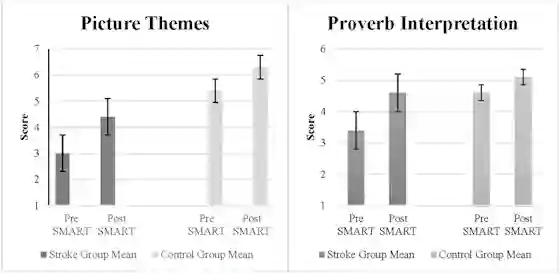
OVERVIEW
Stroke is no longer just an older adult's condition — young women are increasingly experiencing strokes, often facing persistent difficulty with executive function, the cluster of mental skills that powers planning, problem-solving and memory. These deficits strike at a particularly demanding life stage, when women are managing careers, education, childcare and relationships — all of which depend heavily on sharp cognitive performance. Yet this population has been largely overlooked in rehabilitation research. This pilot study tests whether a SMART™ (Strategic Memory Advanced Reasoning Training), a structured, strategy-based cognitive training program, can meaningfully improve executive function and daily-life confidence in young women living with the long-term effects of stroke.Researchers enrolled eight women with chronic-stage stroke (average age ~39) and eight age- and education-matched women without stroke as a comparison group. All participants completed 10 one-hour SMART sessions over five weeks, delivered virtually via Zoom, making the program accessible regardless of where participants lived. The SMART program trained three core thinking strategies: filtering out noise to focus on what matters most, drawing big-picture meaning from complex information, and staying mentally flexible. Before and after training, participants were assessed on measures of executive function, daily living skills, self-confidence in cognitive tasks, community integration, and emotional well-being including depression, anxiety and stress.The results paint an encouraging picture. Women with stroke showed statistically significant improvements in abstraction, strategic memory, fluency of ideas, cognitive self-efficacy and stress — all with large effect sizes, a strong signal even in a small sample. Participants also rated the program highly for acceptability and real-world fit, and many reported applying SMART strategies directly to workplace and home challenges. The findings point to two priority areas for future research: larger, fully-powered clinical trials to confirm these results at scale, and routine executive function screening for young stroke survivors, whose cognitive difficulties are often overlooked because stroke at a young age is frequently — and incorrectly — assumed to mean better outcomes. The success of the virtual delivery format also opens the door to reaching young women who lack access to traditional in-person rehabilitation.Figure 1. (A) Picture themes and (B) proverb interpretation scores in stroke and control groups.