Facebook pixel
Go to home page
Person with short blonde hair and blue shirt standing by window frame, looking thoughtfully to the side.

The Intersectionality of Cannabis Use and Depression Symptoms on Functional Brain Topology in Adults

Drug and Alcohol Dependence

Che Liu, Janna Cousijn, Emese Kroon and Francesca M. Filbey

Read full research protocol

OVERVIEW

Researchers from UT Dallas and Erasmus University Rotterdam analyzed brain imaging data from 395 adults ranging in age from 18 to 55 years, drawn from four research sites across the United States and the Netherlands. Of these participants, 223 were current weekly cannabis users and 172 were non-using controls. Depression symptoms were measured using the Beck Depression Inventory (BDI-II), capturing a spectrum from minimal to severe levels across both groups. Using advanced brain imaging (resting-state fMRI) and graph theory analysis — a powerful method for mapping the brain's communication networks — researchers discovered that cannabis users showed measurably more integrated and efficient brain network function compared to non-users. However, this effect was significantly diminished when depression symptoms entered the picture.

“”

THE AUTHORS CONCLUDE "The co-occurrence of depression symptoms and cannabis use, compared to cannabis use alone, may be associated with less efficient and less integrated brain network function."
In plain terms: Cannabis use alone appeared to alter brain connectivity in one direction, but depression symptoms pulled that effect back — suggesting the two conditions interact in ways that leave the brain operating in a more compromised state than either condition alone would predict.The interaction was most pronounced in global brain network measures and was also observed in key networks governing decision-making, emotional regulation, reward processing and behavioral control — including the frontoparietal and subcortical networks. These findings underscore the importance of examining cannabis use and depression not in isolation, but as interacting variables that together produce a distinct neurofunctional profile — a critical consideration for both clinical practice and the design of future neuroimaging research.
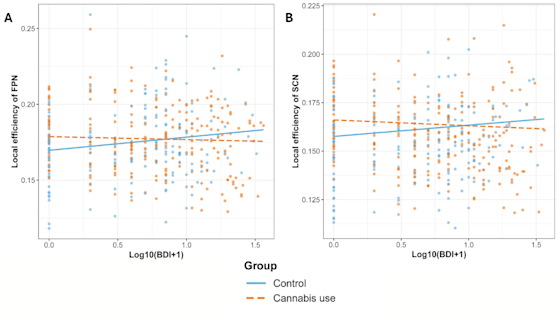
Excerpt of Fig. 3 from The Intersectionality of Cannabis Use and Depression Symptoms on Functional Brain Topology in Adults, showing collected data in the form of graphs tracking the interaction between depression symptoms and cannabis group on local graph measures of frontoparietal network (FPN) and subcortical network (SCN).

EXCERPT from Fig. 3: The interaction between depression symptoms and cannabis group on local graph measures of frontoparietal network (FPN) and subcortical network (SCN) (without FDR correction). PICTURED: A. and B. Depression symptoms moderated the effect of group on local efficiency of FPN and SCN, respectively. NOT PICTURED: C. and D. Depression symptoms moderated the effects of group on clustering coefficient of SCN.


Share this article


Francesca Filbey in dark blue blouse with lights, portrait. Professor and Director of Cognitive Neuroscience Research of Addictive Disorders; Bert Moore Chair; Associate Provost, UT Dallas

Francesca Filbey, PhD

Bert Moore Chair in BrainHealth Professor, School of Behavioral and Brain Sciences Director, Neuroimaging of Reward Dynamics (NiRD) Lab


Related Information

A young woman sleeps restfully in a gently lit bedroom.

Interactions Between Cannabis Use and Chronic Pain on Sleep Architecture: Findings from In-Home EEG Recordings

Although pain and sleep disturbances drive medicinal cannabis use, effects of cannabis and chronic pain on sleep architecture have been studied mainly in isolation, until now. New BrainHealth research aims to integrate understanding, guide treatments and minimize risks by determining interactive effects of cannabis use on chronic pain and sleep.

A college student sleeps soundly in fetal position as morning light comes in the window.

The Role of Sleep in the Link Between Cannabis Use and Memory Function

Despite heightened interest in medicinal cannabis, the impact on memory and sleep remains unknown and under-researched. A groundbreaking new study led by Center for BrainHealth's Francesca Filbey, PhD, focuses on the link between sleep quality, cannabis use and memory.

Dr. Francesca Filbey, pictured smiling and sitting at a desk. She is the director of Cognitive Neuroscience Research in Addictive Disorders at the Center for BrainHealth and an associate professor in the School of Behavioral and Brain Sciences at UTD.

CPDD Announces New President-Elect and Board of Directors Members

Dr. Francesca Filbey was announced as a new member of the Board of Directors for the College on Problems of Drug Dependence, a membership organization that serves as an interface among governmental, industrial and academic communities.