
Facebook pixel
Go to home page
A young woman sleeps restfully in a gently lit bedroom.

Neurotherapeutics

Tracy W. Brown and Francesca M. Filbey

Read full research article
OVERVIEW

Despite pain and sleep disturbances being primary reasons for medicinal cannabis use, the effects of cannabis and chronic pain on sleep architecture have been studied mainly in isolation.New BrainHealth research aims to create an integrated understanding to guide treatments and minimize risks in this population. Led by Tracy Brown, a UT Dallas cognition and neuroscience PhD student working in Dr. Francesca Filbey's Laboratory of Neuroimaging of Reward Dynamics, the study seeks to determine the interactive effects of regular cannabis use on chronic pain and sleep.A total of 339 nights (2273.43 hours) of in-home sleep electroencephalogram (EEG) recordings were collected from 60 adults (32% self-reporting chronic pain and 47% self-reporting cannabis use) over seven consecutive nights per participant. A mixed-model repeated-measures ANCOVA tested the main effects and interactions of chronic pain and regular cannabis use on total sleep time (TST), total slow-wave sleep (SWS), total rapid-eye-movement (REM), sleep onset latency (SOL), and number of awakenings.Results indicate a significant main effect of cannabis use on SWS, TST, SOL and REM. Significant interactions emerged between cannabis use and chronic pain on SWS and REM sleep, indicating a tradeoff. Increased SWS comes at the cost of less REM sleep – the kind of sleep that is critical for emotional regulation and memory integration. Additionally, while cannabis may initially enhance SWS, benefits diminish with chronic use. These findings may reflect a dysregulated sleep response in individuals using cannabis to manage chronic pain, highlighting the need to consider both beneficial and detrimental effects of cannabis on specific sleep stages.
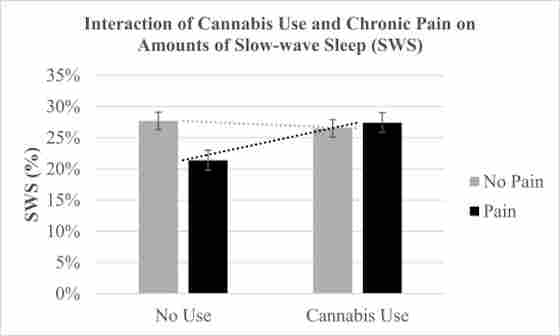
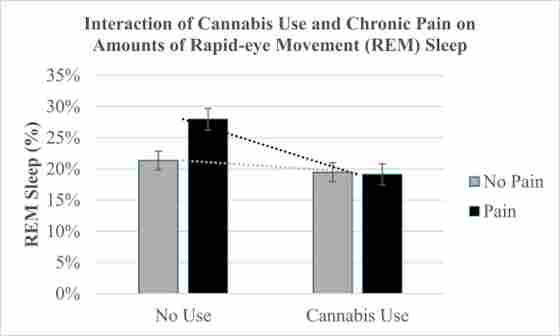
The figures below demonstrate mean (± SE) change in SWS and REM duration. In those with no pain, SWS decreased 1.19% and REM decreased 1.88% with cannabis use. In those with chronic pain, SWS increased 6.00% and REM decreased 8.85% with cannabis use.
Figure 1. The interaction of regular cannabis use and chronic pain on the percentage of slow-wave sleep (SWS). The mean (SE) values were 27.41% (.02) for chronic pain and cannabis use, 26.49% (.01) for no pain and cannabis use, 27.68% (.01) for no pain and no cannabis use, and 21.41% (.02) for chronic pain and no cannabis use.

Figure 1. The interaction of regular cannabis use and chronic pain on the percentage of slow-wave sleep (SWS). The mean (SE) values were 27.41% (.02) for chronic pain and cannabis use, 26.49% (.01) for no pain and cannabis use, 27.68% (.01) for no pain and no cannabis use, and 21.41% (.02) for chronic pain and no cannabis use.

Figure 2. The interaction of regular cannabis use and chronic pain on the percentage of rapid-eye movement (REM) sleep. The mean (SE) values were 19.11% (.02) for chronic pain and cannabis use, 19.47% (.02) for no pain and cannabis use, 21.35% (.02) for no pain and no cannabis use, and 27.96% (.02) for chronic pain and no cannabis use.

Figure 2. The interaction of regular cannabis use and chronic pain on the percentage of rapid-eye movement (REM) sleep. The mean (SE) values were 19.11% (.02) for chronic pain and cannabis use, 19.47% (.02) for no pain and cannabis use, 21.35% (.02) for no pain and no cannabis use, and 27.96% (.02) for chronic pain and no cannabis use.

Share this article


Francesca Filbey in dark blue blouse with lights, portrait. Professor and Director of Cognitive Neuroscience Research of Addictive Disorders; Bert Moore Chair; Associate Provost, UT Dallas

Francesca Filbey, PhD

Bert Moore Endowed Chair and Professor, School of Behavioral and Brain Sciences Director, Neuroimaging of Reward Dynamics (NiRD) Lab


Related Information

Francesca Filbey, PhD, and her lab outside Center for BrainHealth.

Center for BrainHealth Investigates the Relationship Between Cannabis Use, Sleep and Memory

Growing legal use of cannabis has piqued interest in potential side effects, particularly on memory and sleep, effects that until now have only been studied separately. New research led by BrainHealth's Francesca Filbey, PhD, in collaboration with University of Amsterdam, aims to fill the gap.

Dr. Francesca Filbey, pictured smiling and sitting at a desk. She is the director of Cognitive Neuroscience Research in Addictive Disorders at the Center for BrainHealth and an associate professor in the School of Behavioral and Brain Sciences at UTD.

NIH Awards Center for BrainHealth's Dr. Francesca Filbey $2.5M to Investigate Cannabis Use Disorders

The National Institutes of Health (NIH) recently awarded the Center for BrainHealth at The University of Texas at Dallas $2.5 million to examine cannabis use disorders.

Dr. Francesca Filbey in a blue blouse with the background blurred

NiRD Lab

Led by Dr. Francesca Filbey, PhD, The Neuroimaging of Reward Dynamics (NiRD) Lab aims to characterize neural mechanisms related to dopaminergic-reward system dysfunction, such as substance use. They take an interdisciplinary approach and utilize a variety of techniques that include clinical interviews, physiological measures, cognitive testing, neuroimaging (EEG, MRI), neuromodulation (HDtdCS, taVNS) and genetic analysis.