BRAINOMICS BULLETIN
Open Printable PDFWhile the Brainomics team usually focuses on the economic benefits of brain health, people only realize brain gains when behavior actually changes. This raises an important question: how can organizations (where we spend ~90,000 hours of our lives) foster lasting change that leads to human and economic benefit?3The science of brain-healthy habits, and how individuals can build them, is well established. Extensive research by our cognitive neuroscience colleagues demonstrates that people who consistently engage in brain-healthy practices will likely see a measurable improvement in their brain’s fitness and performance in areas such as clarity, productivity and engagement.4But the real challenge is how to make it happen at scale. Anyone who’s made – and subsequently broken – a New Year’s Resolution knows how hard it can be to change your individual habits. Now, imagine how exponentially more challenging it is for an entire organization to build and sustain a culture that promotes brain health – but there are ways to do it.
The Science of Team Dynamics
We’re starting to understand that even if the whole organization does not immediately go brain-healthy, a critical mass of employees can be reached to drive the transformation. What begins as one person's habit becomes a new team norm, and as individual teams embrace brain health concepts and make meaningful progress within their own contexts, they can catalyze a shared experiential shift that ignites broader organizational change.For an organization to see real benefits, upwards of 25% of employees must be engaged in a brain health journey to create a critical mass tipping point for social change.⁵So how do we reach and engage these crucial change agents?The workplace environment plays a major role in determining which behaviors are reinforced. Each team’s dynamic shapes which practices are rewarded or perceived as socially safe, and whether employees believe in their own cognitive capacity to sustain change. Adopting new behaviors requires higher cognitive effort and deliberate thinking. Early in the process of behavior change, individuals must consciously redirect attention and set an intention to stop many compulsive or comfortable routines, often tolerating feelings of uncertainty and discomfort that come with building new habits. These processes tax the brain’s executive control systems, making behavior change cognitively expensive.6This is where team dynamics can play a transformational role. When new, brain-healthy behaviors are misaligned with preexisting norms, unsupported by managers or seem di˙cult to practice in the work environment, employees must continually expend an outsized amount of brain energy to maintain the old routine. Remember the lesson of Sisyphus pushing that boulder up a hill? When faced with competing demands, the brain often defaults to familiar routines. Taking shortcuts reduces the cognitive load – even when an individual understands and wants to seek the benefits of healthy cognitive change. On the upside, when teams reinforce and normalize brain-healthy behavior, they can reduce the cognitive burden, making it much easier for brain-healthy habits to stick. Team adoption can also create a powerful social influence: people have an innate desire for belonging and connectedness, making them more likely to embrace shared behaviors. Simply put, everyone wants to be part of the brain-healthy club.How to Instigate Brain-Healthy Organizational Change
Organizations that want to foster brain-healthy habits must create environments that encourage adoption and maintenance. In our experience working with organizations from the private sector to the military, we have identified three key factors that support organizational change.#1 Leadership Buy-In
#2 Group Champions

#3 Gatekeepers as Culture-Builders

Together, these three factors help build environments that minimize cognitive friction and make brain-healthy habits easier to sustain.
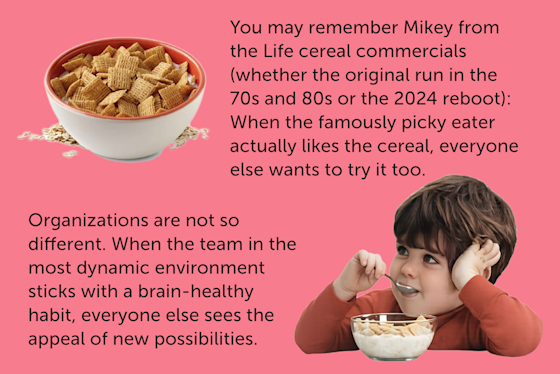
WHAT MIKEY CAN TEACH US ABOUT ORGANIZATIONAL CHANGE
“”
Durable behavior change is a function of incentives and environment — not willpower. The most successful public health campaign in modern history, anti-smoking, didn't just lecture people on quitting. It made cigarettes expensive, made smoking spaces scarce, and stripped triggering images from popular media. Once a critical mass of non-smokers emerged, social norms finished the job. Organizations serious about brain health need the same logic: stop asking people to try harder, and start structuring incentives and the environment so that the healthy choice becomes the easy choice.
— Andy Feltovich, Founder & CEO of Feltovich Fit
- Gast A, et al. (2024). All About Teams: A New Approach to Organizational Transformation. McKinsey & Company
- Ewnstein B, Smith W and Sologar A (2015). Changing Change Management. McKinsey & Company
- Center for BrainHealth. (2026). Why Brain-Healthy Organizations Will Win the Next Era of Transformation. White Paper Series
- Cook L, et al. (2026). Measuring and Increasing the Brain Health Span Across Adulthood: A Public Health Imperative. Nature: Scientific Reports
- Centola D, et al. (2018). Experimental Evidence for Tipping Points in Social Convention. Science
- Friedman N & Robbins T. (2022). The Role of Prefrontal Cortex in Cognitive Control and Executive Function. Neuropsychopharmacology
- Center for BrainHealth. (2024). KepnerCPA Case Study. Brainomics Bulletin