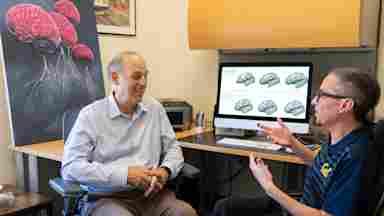
In the above photo, Dr. Mark D’Esposito (left) and Kevin Weiner discuss Weiner’s research on grooves and folds in the human brain and how they relate to cognitive function and a healthy brain. Photo Credit: Brandon Sanchez Mejia for UC Berkeley.
What’s a healthy body without a healthy brain? Neurologists, neuroscientists and psychologists unite to find metrics for brain health and effective training to improve it.Overview
Researchers, clinicians and neuroscientists are working to establish measurable indicators of brain health, identify evidence-based interventions and create scalable tools that help people strengthen resilience, cognition, emotional well-being and overall brain performance throughout life. Center for BrainHealth collaborations and initiatives are helping to advance translational science, develop practical brain health metrics and optimize human brain function, rather than simply address disease. During his 25-year association with Center for BrainHealth, UC Berkley Distinguished Professor Mark D'Esposito, MD, has focused on preventive neurology, promoting a shift from treating disease to optimizing health and observing an increase in preventive approaches to brain health. Establishing itself as a worldwide center of translational research focused on measuring and boosting brain function, Center for BrainHealth recently recruited former UC Berkeley sleep scientist Matthew Walker, PhD, to serve as inaugural director of the new Sleep Innovation Laboratories, alongside Berkeley postdoctoral fellow Eti Ben Simon, PhD, as associate director. The goal of the Sleep Innovation Laboratories is to translate “the latest neuroscience research into evidence-based strategies that can optimize your sleep.”“”
Dr. Ben Simon says: “We want to use technology to understand sleep better, but also to try and offer the latest innovations that can help people achieve better sleep. If we think about brain health, we cannot ignore sleep. And we’re talking about not just keeping the brain away from disease, but actually really helping it thrive.”
The work positions brain health as a lifelong endeavor and a societal asset, emphasizing prevention, optimization and human potential rather than solely disease treatment. Read more at UC Berkeley News