Overview
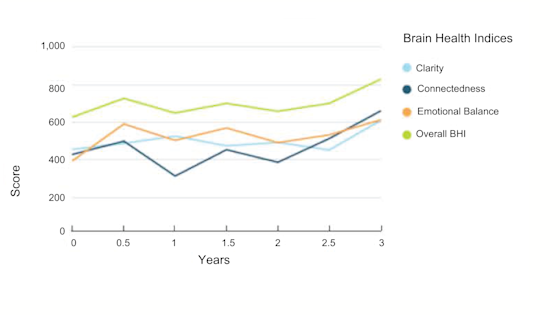
Read full research articleThe dominant narrative around brain aging has been one of a slow, irreversible dimming that begins earlier than most people realize and ends in cognitive decline. Neural and cognitive functions in healthy adults can begin to decline as early as the late twenties, even in the absence of injury or disease, yet the field of brain health has remained focused on fixing what's gone wrong rather than prevention. Researchers at Center for BrainHealth are challenging that paradigm with a new concept — brain health span — the length of time a person can maintain, enhance, or regain cognitive, social and emotional well-being without entering a trajectory of continuous decline. Their measurement tool, the BrainHealth Index (BHI), treats the brain less like a patient to diagnose and more like an athlete to coach: scoring not against population norms, but against each person's own previous best.To test whether brain health span can actually be extended at population scale, researchers enrolled 3,966 adults between the ages of 19 and 94 in The BrainHealth Project, an online initiative integrating the BrainHealth Index with cognitive training, lifestyle modules and coaching. Every six months for three years, participants completed the BHI — a rich, multidimensional assessment spanning not just cognition but also social connectedness, emotional balance, sleep, resilience and purpose. Between assessments, they engaged with bite-sized daily training modules built around SMART (Strategic Memory Advanced Reasoning Tactics), a strategy-based cognitive training protocol designed to strengthen the brain's executive functions — the mental command center governing attention, reasoning and adaptability. Participants could also access one-on-one coaching sessions, habit trackers, and a curated library of brain health resources, all through a desktop or mobile platform. Crucially, the research team tracked not just whether people improved, but how much they engaged — classifying participants into low, modest, and high utilization groups to understand the relationship between effort and outcome.The results make a compelling case for rewriting the story about aging brains. The general pattern of longitudinal change for the overall BrainHealth Index score was one of monotonically increasing change throughout the 3-year study period, with a cumulative gain that was highly statistically significant — and this held true regardless of participants' age, gender, or education level. Perhaps most striking, those who switched to higher-level utilization over the following six months had higher mean changes on the indices through one year, while those who remained disengaged showed no meaningful change at all — a finding that points squarely to self-agency, not biology, as the pivotal variable. The authors argue this study is to brain health what the Framingham Heart Study was to cardiovascular disease: a long-overdue longitudinal foundation for proactive, population-level prevention. Future work must urgently address the study's demographic skew — the sample was predominantly white and highly educated, which may limit the generalizability of the current findings to broader populations — and integrate biomarkers like neuroimaging and wearable sensors to connect behavioral gains to measurable changes in the brain itself. The larger ambition is nothing short of a public health transformation: treating brain performance not as a fixed inheritance, but as a lifelong practice.Below: Graph of Case #1 shows the trajectory of a male in his 60s with a bachelor's degree. Employed full time, he also serves as a caregiver for a family member with dementia.