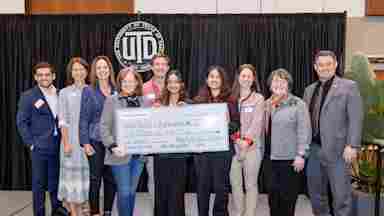
Initiative is one of multiple philanthropy-driven investments to equip the next generation with brain-healthy strategies.The University of Texas at Dallas has piloted the first-ever Brain Health Prize, a student competition to bring innovative ideas to improve brain health on campus. The winners were announced during a NextGen event kicking off BrainHealth Week 2026, which featured speakers Tessy Ojo, CBE, and Geoff Ling, MD, PhD, as well as a showcase of the top 20 student submissions. University of Texas System regent Christina Melton Crain, ESQ, awarded the inaugural prize.
An Award with a Mandate
The Brain Health Prize is a peer-to-peer competition that encourages novel ideas to improve brain health on college campuses, offering students the opportunity to demonstrate their leadership, innovation and impact. To ensure the winning idea turns into action, half of the $5,000 first prize is dedicated to implementation, with the other half awarded as a stipend to the winning student or group.The theme for this year was “Stress for Action.” Neuroscience shows that the right amount of stress (called eustress) can actually sharpen focus, boost motivation and fuel productivity. We control our stress response by understanding our triggers and equipping ourselves with the right tools.Winning Submissions
FIRST PLACE: Shreeyalaxhmee Rao and Riya Acharya Resilience Neighborhoods create a unified, campus-wide system to build stress resilience through both in-person advocates and a digital, gamified connection. RUNNER UP: Elena Tran The Rewrite Project introduces interactive Rewrite Wall pop-ups, reflection-based activities, a Freshman Seminar module and a digital storybook to create a living archive of resilience and belonging. RUNNER UP: Alekya Tanikella, Aiswarya Saravanan, Isha Rojanala and Jyotsna Tera Project Perihelion helps students harness eustress through daily practice, peer engagement the creation of a Eustress Coalition and interactive events that make learning about eustress hands-on, engaging and fun.About the Collaborative
The Brain Health Prize was launched by the Brain Healthy Campus Collaborative, a first-of-its-kind initiative to build brain-healthy campuses through student-led strategies and a holistic, proactive approach supporting the wellbeing of the entire campus community. Founding members include Center for BrainHealth, Hilarity for Charity (HFC), RADical Hope and Waves. UT Dallas piloted the Brain Healthy Campus concept and the Brain Health Prize in 2025; additional participating campuses will be announced in August 2026 as the initiative expands nationwide.The event organizers wish to especially thank Waves, which provided the funding for the student prize. Additional sponsors include Perkins&Will and Marie Park and Joe Hardt. Program funding was provided by RADical Hope.Members of the Collaborative Weigh In
“Young adults on campuses across the country are experiencing record levels of stress and anxiety from life’s everyday challenges,” said Liz Feld, CEO of RADical Hope. “Peer-driven strategies to support their brain health are the most effective ways to help them thrive – now and in the future. The Collaborative is a catalyst to turn this approach into action, wherever students are.”"If we can empower young people everywhere to understand and care for their brains early, we will unlock human potential on a scale we've never seen,” said Brian Magierski, co-founder and CEO of Waves. “Waves is proud to support the Brain Healthy Campus Collaborative because the earlier we invest in brain health, the more years of purpose, resilience, and thriving we empower every young person to realize. And the payback for all of society will be enormous!"“It's never too early to take care of your brain. Dementia prevention starts with awareness, education, and early action. By empowering students to adopt brain health habits as young adults, we can protect cognitive health, reduce dementia risk, and change the trajectory of Alzheimer’s disease and related dementias,” said Alexandra Villano, senior director of program development and strategy at Hilarity for Charity (HFC). “Through this Collaborative, HFC is helping bring evidence-based strategies to campuses, transforming students into informed leaders and campuses into environments that support lifelong brain health.”“”
“As part of a university, working with students and young adults is part of our DNA,” said Lori Cook, PhD, CCC-SLP, director of clinical research at Center for BrainHealth. “Research is continually expanding the tools and strategies that can help people thrive in every stage of life. By bringing brain-healthy practices to college campuses, we are not just educating but also empowering and equipping the next generation to prioritize their brain health and optimize their brain performance to fuel their success.”
Building a Brain Healthy Campus
At its core, a Brain Healthy Campus recognizes that when we protect and strengthen the brain, every dimension of campus life improves – learning, discovery, leadership, belonging and long-term success. A Brain Healthy Campus aims to move beyond maintenance of baseline wellness to the elevation of brain performance. It integrates brain health into the institutional fabric to promote cognitive enhancement, resilience, and critical reasoning for the entire campus family: students, staff, faculty, administrators, and alumni.Philanthropy Driving Campus Initiatives
Early investment from The Hoglund Foundation has been pivotal in advancing brain health among young adults. Much of the work is focused on training key staff and student leaders, building connections, and customizing resources, helping to address the critical need to engage younger generations in brain health early, to help them thrive in school, career and community.The Meadows Foundation awarded a grant for Center for BrainHealth to conduct the foundational work to deliver science-based tools for resilience and cognitive performance to Dallas College and UT Dallas. The program provides access to interactive workshops and courses focused on stress management, sleep and cognitive strategies for students, faculty and staff. This initiative empowers next-generation leaders with practical tools to enhance mental clarity, emotional well-being and academic performance.Why it Matters
Proactive brain health supports mental health, resilience, the refinement of brain skills and ability to thrive. College provides a critical window for intervention and the development of brain-healthy daily habits that can make a lifelong difference.- 75% of lifetime mental health conditions emerge by age 24 (NAMI, 2025), making college a pivotal time to build coping and resilience skills
- The top skills employers demand are brain skills (World Economic Forum, 2025):
- Analytical thinking
- Resilience, flexibility and agility
- Leadership and social influence
- Creative thinking
- Motivation and self-awareness