
Facebook pixel
Go to home page
Silhouettes of people facing a glowing blue digital brain in a futuristic neon cityscape with streaming light particles.

Longitudinal Surface-Based Morphometry Reveals Potential MRI Biomarkers Correlated With Multidimensional Brain Health Measures

Brain Imaging and Behavior

Robyn A. Honea, Ankit Patel, William Guller, Mark D'Esposito, Sandra Bond Chapman, Lori G. Cook and Jeffrey Spence

Overview

Read full research articleThis study investigates whether changes in brain structure measured by MRI are associated with changes in the BrainHealth Index (BHI), Center for BrainHealth's multidimensional measure of cognition, emotional well-being, and social connectedness. Findings suggest specific aspects of cortical complexity, particularly gyrification index (GI), sulcal depth (SD), and fractal dimension (FD), may serve as biomarkers of brain health across adulthood. Researchers from Kansas University Medical Center, UC Berkeley, and Center for BrainHealth at UT Dallas analyzed data from 190 healthy adults between the ages of 20 and 70 years (94 women and 96 men). Participants completed online BHI assessments, had access to optional brain health training and underwent up to five MRI scans over approximately four years using a Siemens Prisma 3T scanner at Center for BrainHealth. Investigators used longitudinal surface-based morphometry analyses to examine changes and then evaluated how these measures related to baseline BHI scores and changes in BHI over time. Overall, the study supports the idea that subtle structural brain measures can help track positive changes in brain health over time and may provide objective markers for monitoring cognitive, emotional, and social functioning. Building upon prior research conducted as part of The BrainHealth Project, this research shows that BHI scores can improve over time and are associated with functional neuroimaging measures such as hemodynamic responses. While previous studies have linked cognitive training and lifestyle interventions to changes in brain structure and function, most have been cross-sectional or focused on narrow cognitive outcomes. This study extends the field by examining longitudinal structural brain changes linked to a holistic measure of brain health that incorporates cognitive, emotional, and social domains, and results further indicate that brain health trajectories may differ by sex, with distinct neuroanatomical patterns emerging in men and women.By identifying MRI-derived markers that track with BHI improvements, the research advances efforts toward precision brain health, where interventions may be tailored according to an individual's neuroanatomical profile. The findings also strengthen evidence that the adult brain retains significant capacity for neuroplastic adaptation and suggest that structural MRI measures could eventually help evaluate the effectiveness of brain health interventions in real-world settings.
Figure 4. Brain surface overlay showing regions where increase in the BrainHealth Index correlated with increased structural brain health in men and women.
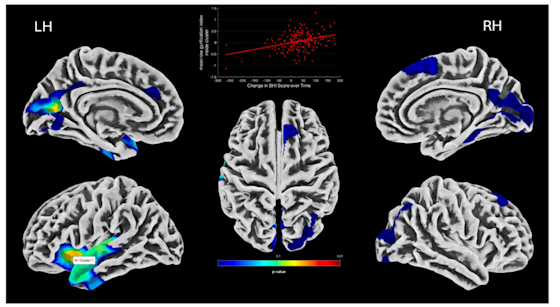
Brain surface overlay showing regions where increase in the BrainHealth Index correlated with increased structural brain health in men and women.
Read full research article

Share this article


Dr. Mark D'Esposito is a distinguished professor of neuroscience and psychology at the University of California, Berkeley and the Carol Heller BrainHealth Project Co-Leader.

Mark D’Esposito, MD

Co-Leader, The BrainHealth Project

Sandi Chapman, Founder and Chief Director, Center for BrainHealth, Co-Leader, The BrainHealth Project, Dee Wyly Distinguished Professor

Sandra Bond Chapman, PhD

Chief Director Dee Wyly Distinguished Professor, School of Behavioral and Brain Sciences Co-Leader, The BrainHealth Project

Lori Cook in a blue blouse with blue lights, portrait. Director of Clinical Research, BrainHealth Research; Head of Research, The BrainHealth Project; Adjunct Assistant Professor, School of Behavioral and Brain Sciences

Lori Cook, PhD, CCC-SLP

Director of Clinical Research Head of Research, The BrainHealth Project Adjunct Assistant Professor, School of Behavioral and Brain Sciences

Headshot of Jeffrey S. Spence, PhD

Jeffrey S. Spence, PhD

Director of Biostatistics


Related Information

Businessman contemplating in the office looking through the window working on a laptop

BrainHealth Index

The BrainHealth Index is a holistic measure of brain health performance, capturing the immense complexity of human brain performance as defined by the World Health Organization (WHO, 2022).
Founding members of the BrainHealth Network convene in a sunlit corner of Center for BrainHealth during BrainHealth Week 2026. The groundbreaking research collaborative will enable data sharing to accelerate discovery.

Center for BrainHealth Forms Groundbreaking Research Collaborative to Enable Data Sharing, Accelerate Discovery

Connecting researchers across the country, the BrainHealth Network launched in February 2026. The groundbreaking collaborative research initiative seeks to leverage advanced MRI imaging and data analysis from one of the most comprehensive multimodal brain imaging datasets ever assembled in order to understand brain health improvement.

A joyful multigenerational family laughing outdoors in a green field, with a mother lifting a young child while grandparents smile nearby.

Measuring and Increasing the Brain Health Span Across Adulthood: A Public Health Imperative

BrainHealth researchers are challenging assumptions about brain aging through The BrainHealth Project and their proprietary measurement tool, the BrainHealth Index (BHI) — measuring brain health span, the length of time a person can maintain, enhance, or regain cognitive, social and emotional well-being without a trajectory of continuous decline.