BRAINOMICS CASE STUDY
Open Printable PDFSituation
As the largest provider of mental health, developmental disability and permanent supported housing services in Dallas County, Metrocare has a team of more than 1,100 employees serving over 50,000 children, teens and adults in North Texas each year. Recently, the organization partnered with Center for BrainHealth to implement a BrainHealthy Workplace™ engagement designed to translate brain health research into practical workplace strategies.Business Case
Metrocare employees navigate emotionally demanding, high-pressure environments daily. Their leadership recognizes the value of brain health education and awareness as a proactive, non-stigmatizing way to equip staff with practical strategies that enhance focus, mental clarity, creativity and overall bandwidth. By making brain health a cultural priority, they seek to optimize employee well-being at work and at home, while simultaneously strengthening client care.What We Did: Phase 1
Visible Leadership Support
Metrocare’s C-suite completed two-day Strategic Memory Advanced Reasoning Tactics (SMART™) training led by experts at Center for BrainHealth. Training highlighted practical techniques for managing mental energy, thinking strategically and becoming more innovative. Executives gained appreciation for the overarching relevance of brain health to both individuals and teams, strengthening senior leadership’s commitment to extending the initiative across the organization.Champion-Led Training
Metrocare’s internal health ambassadors completed SMART training to build personal brain health awareness and knowledge. These trusted leaders then had the opportunity to self-select as champions equipped to disseminate brain-healthy strategies to their teams. Champions led topic-specific training “sprints” focused on strategic attention and innovation, making organization-wide implementation readily scalable and cost-effective.Shared Language for Team Impact
The short, intensive structure of these sprints enabled teams to practice one highly meaningful strategy at a time. Champions adapted strategies to the unique strengths and needs of each team, energizing workplace culture and even fostering the creation of shared language through brain-healthy behaviors. For example, teams developed door signs to use while working on high-cognitive-load tasks to protect their focus time.What We Learned
Post-sprint pulse surveys and mid-sprint qualitative questionnaires demonstrated stronger productivity and capacity for innovation. From baseline to the end of the fourth sprint, participants reported increases in focus (+34%), mental energy (+25%), creativity (+19%) and the ability to manage daily demands (+17%).With continued CEO support, Metrocare is well positioned to continue showing measurable progress on existing KPIs as results continue to emerge.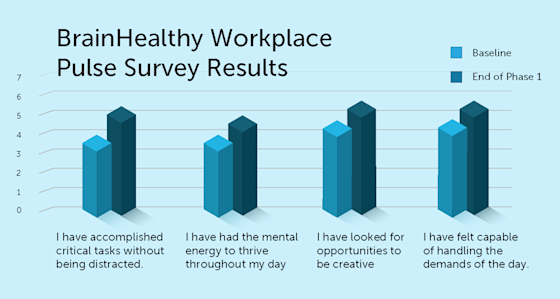
➡️3 Action Steps
#1 Educate leaders on brain health. Make their efforts visible to inspire an organizational culture of brain health.#2 Scale up brain-healthy practices. Activate your trusted internal champions to apply the train-the-trainer model. #3 Create a shared language. Establish team practices to drive positive change at both individual and team levels.What's Ahead: Phase 2 – Integration
Phase 2 positions the concept of brain health as an integrated part of Metrocare’s culture and operational rhythm. The goal is to embed science-based BrainHealth principles and strategies into how Metrocare communicates, trains, leads and supports staff across the organization.Phase 2 will measure and seek to reduce burnout, a key metric identified by Metrocare.Phase 2 Priorities
- Managers receive SMART brain training.
- Staff are equipped with ongoing access to tools and resources, including the BrainHealth Platform.
- Champions lead staff educational engagements each quarter.
- Experts from Center for BrainHealth continue to share resources and ongoing guidance