BRAINOMICS BULLETIN
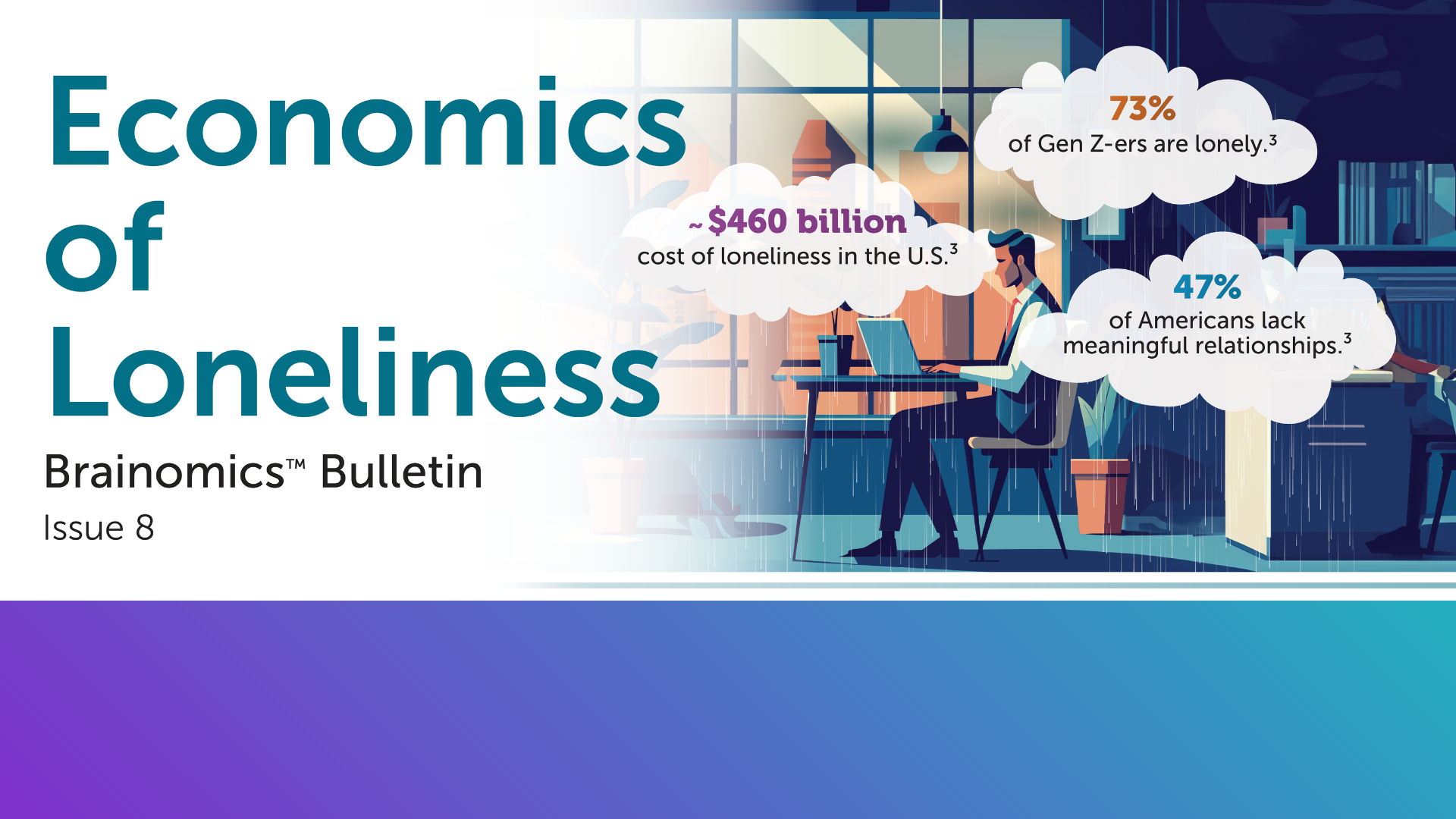
Open Printable PDFThe Brainomics team has become increasingly concerned about the widespread effects of loneliness. Current statistics point to this being among the most pressing challenges facing modern societies. And a growing body of research suggests that one’s ability to cultivate meaningful connections is a core facet of brain health2,3; in other words, without connectedness we cannot fully optimize our brain’s fitness and performance.For this reason, we’d like to revisit the bulletin on loneliness we wrote two years ago. The first time we wrote this bulletin, we quoted the statistic that loneliness costs the U.S. economy $406B from absenteeism alone⁴ – about 1.3% of the country’s GDP. As our analysis deepens, evidence suggests that loneliness drives broader economic effects — resulting in a holistic cost far greater than initially anticipated.
Those experiencing loneliness
- Are less productive⁵
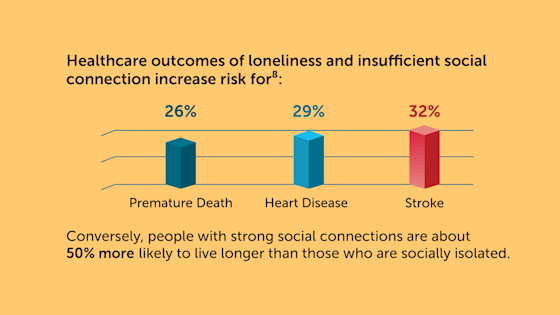
- Have higher healthcare costs, worse health outcomes, and higher rates of premature death⁶
- Have a lower likelihood to be in the workforce and positively contribute to GDP⁷
- Higher-than-average absenteeism rates⁸
At least four major economic costs are tied to loneliness — and even conservative estimates suggest it affects roughly 32% of the population.⁴ Taken together, the evidence points to a clear conclusion: the true economic loss is well above 1.3% of GDP.Loneliness is certainly a challenge to overcome in today’s fast-paced society where phones and headphones often block real social connection. But there’s reason for hope: a growing movement is helping people reframe loneliness as a shared challenge, rather than an individual defect — and an issue that organizations and communities are increasingly taking on together. Governments are increasingly treating loneliness as a public health and economic priority — and several countries have already launched national initiatives to rebuild social connection.The Public Health Agency of Sweden has developed a national strategy to tackle loneliness and promote community. In 2019, the UK created the role of Minister for Loneliness, reflecting a national commitment to reduce isolation. The U.S. also took action to foster connectedness in 2023 with the Surgeon General declaring a national loneliness and isolation epidemic and generating a Framework for a National Strategy to Advance Social Connection. Each of these initiatives has had some success combating the loneliness epidemic. Private nonprofits are also generating solutions that target social isolation. For instance, Beluga Pods is a platform designed to generate moments of connection and draw attention to how widespread loneliness creates a systemic challenge with measurable consequences for communities and organizations.
“”
Loneliness is not a weakness or a personal failing – it’s a systematic and structural problem. We must commit to real connection through small, meaningful, measurable actions. Less is more, and more is human.
— Georgie Cox, Founder of Beluga Pods
Five years ago, many people may have thought there was nothing that could be done about the pervasiveness of loneliness in our society. We are, thankfully, moving away from this complacency. With recognition of self-agency as the starting point, and advanced by supportive social structures and tools, many groups are turning their attention toward the loneliness crisis and revving up to create practical, implementable solutions.We’ve said before that integrating neuroscience into our education systems probably generates the highest-impact, lowest-cost policies to promote brain health. We think the second best thing may actually be leaders and entrepreneurs taking on the loneliness epidemic at a societal level.