Facebook pixel
Go to home page
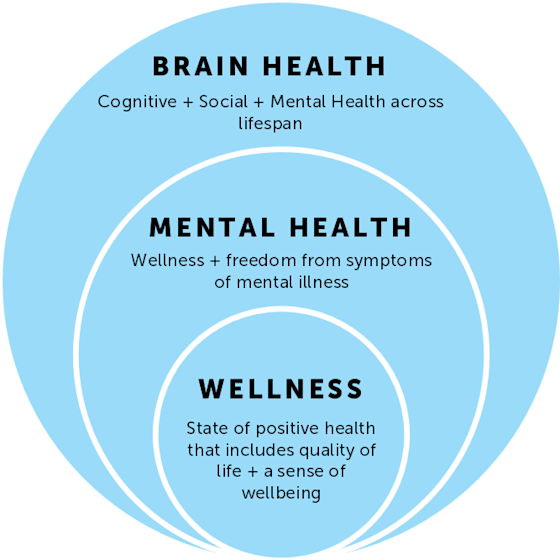
Three nested blue circles showing Brain Health encompassing Mental Health, which encompasses Wellness, each with brief definitions.

Merlo, Sugden and Abascal. (expected, 2023). "Lifestyle Psychiatry: An Overview." Lifestyle Medicine, 4th ed. CRC Press, Taylor & Francis.

Brain Health Is Foundational for Mental Health

Mental health is rooted in brain health. When we strengthen the brain's capacity for attention, reasoning, adaptability and emotional regulation, we create a stronger foundation for well-being.
  • Mental health is more than the absence of illness. It includes resilience, purpose, meaningful engagement, quality of life, and the ability to thrive.
  • Brain health offers a proactive pathway to support these outcomes for people with and without mental illness. 
At Center for BrainHealth, we believe that supporting mental well-being begins with understanding and strengthening the brain. Through research, educational resources and community partnerships, we provide evidence-informed tools that help individuals, families, educators, mentors and organizations support lifelong well-being and flourishing. 
DISCLAIMER: Center for BrainHealth is not a clinical mental health provider. Information and resources are intended for educational purposes only and should not be used as a substitute for professional medical advice, diagnosis or treatment. If you or someone you know is experiencing a crisis, call or text 988 to connect with the Suicide & Crisis Lifeline. For an immediate emergency, call 911 or go to the nearest emergency room. 

Resources, Research, and Community Connections 

Find September Events

Whether you're looking to better understand the relationship between brain health and mental health, support well-being of students and loved ones, or connect with community initiatives, these featured resources offer practical ways to learn, engage, and take action. Start by exploring our research, tools and partnerships that are helping individuals and communities thrive. 

A Proactive Approach to Well-Being

At Center for BrainHealth, our Framework for Flourishing shows how cultivating brain health can support resilience, connection, purpose and overall quality of life. Rather than focusing solely on what happens when things go wrong, this approach emphasizes proactive strategies that help individuals and communities thrive. 
Mental health is often discussed in the context of illness, symptoms or treatment. While those conversations are important, mental well-being also encompasses the capacities that help people navigate challenges, build meaningful relationships, adapt to change and engage fully in life. Brain health provides a foundation for these abilities and offers opportunities to strengthen them throughout life. 
Discover the science behind what helps people thrive. Our Framework for Flourishing white paper examines how brain health contributes to well-being, exploring the factors that help build resilience, find purpose, foster meaningful connections and thrive throughout life.
Sign up to receive new BrainHealth White Papers delivered directly to your inbox.

Related Research

Research from Center for BrainHealth and our collaborators demonstrates that strengthening brain health can improve mental health outcomes in adults with and without mental illness. Findings highlight the potential of proactive brain health strategies as part of a broader approach to supporting emotional well-being and quality of life.

Supporting Students Through Everyday Connections

A smiling college student with curly hair sits on a teal sofa gesturing to a trusted adult to the side of the frame, beside text reading "Alli Brain Health Guides."
The ALLI BrainHealth Guides help trusted adults support young adults through practical, neuroscience-informed strategies that promote resilience, brain health and well-being.
Created in honor of Alli Barge, a young Dallasite remembered for her radiance and kindness, ALLI (Alliance for Living and Learning Intentionally with Brain Health) equips advisors, coaches, faculty members, mentors and other supportive adults with resources they can use in everyday conversations and interactions. 

Working Together to Support Well-Being

Leaders of the Mental Wellness Collective, a collaboration between the YMCA of Metropolitan Dallas, Metrocare Services, Momentous Institute, Grant Halliburton Foundation and Center for BrainHealth, part of The University of Texas at Dallas.
Supporting mental well-being requires collaboration across communities, organizations, educators, healthcare professionals, families, and individuals. 
In that spirit, Project Thrive was crated to bring together organizations committed to promoting wellness, resilience, and flourishing across our communities. By combining expertise, resources, and shared goals, the partnership helps expand access to education, tools, and experiences that support lifelong well-being. 
The mental wellness collective members are the YMCA of Metropolitan Dallas, Metrocare Services, Momentous Institute, Grant Halliburton Foundation and Center for BrainHealth.
Project Thrive logo featuring a brown stylized tree with green and brown circle leaves above green text.

Project Thrive Resources

Access Project Thrive resources to foster collaboration across your community and local organizations.

September Events

Center for BrainHealth is proud to partner with Grant Halliburton Foundation as the organization celebrates 20 years of advancing mental health awareness, education, and support throughout North Texas.
Investing in Brain and Mental Health Education

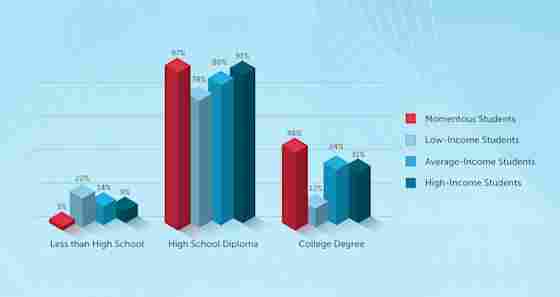
Graphs compare 2016-2018 Momentous cohorts with 2016-2018 averages calculated by the National
Student Clearinghouse Research Center.

Educational Attainment (2016-2018 Cohorts): Graphs above compare 2016-2018 Momentous cohorts with 2016-2018 averages calculated by the National Student Clearinghouse Research Center.

Center for BrainHealth's Brainomics® Venture partnered with the Momentous Institute to understand long-term economic implications of early investment in brain and mental health.
Using data from the National Student Clearinghouse Research Center, teams analyzed academic achievement for select Momentous School cohorts. Based on our analysis, Momentous School alums are more likely to graduate from high school, earn a college degree, and become higher-income earners than many of their non-Momentous peers, supporting the conclusion that the school's early investments in brain health and mental health education pay off, delivering both human and economic returns.
The success of Momentous Institute students strengthens our case for introducing brain-based and mental health strategies in early education, giving tomorrow’s leaders agency over their brain health from the very start of their formal education years.